Best Creamy Potato Soup in 40 Minutes-One Pot

Steam rolls off the bowl, the broth clings thick to the back of your spoon, and somewhere under all that cheese a chunk of potato is just waiting to fall apart at the first touch of your fork. That’s the bowl this potato soup recipe gets you to, and it doesn’t take all afternoon.
This version leans on starchy russet potatoes and a short simmer instead of a long one, so the soup thickens on its own without a heavy flour roux weighing it down. You’re looking at about 15 minutes of prep, 25 minutes on the stove, and a pot that easily feeds a family of five. Potato soup this simple still ends up rich enough to serve on its own with warm bread on the side.

Why You’ll Love This Potato Soup Recipe
- One pot, one hour, no fuss. Everything cooks in the same pot you sauté in, so cleanup is a single dish and a cutting board.
- Naturally thick, no flour needed. Russet potatoes break down as they simmer and thicken the broth on their own, which also means it’s easy to make gluten-free.
- Freezer-friendly base. The soup base (before dairy goes in) holds up well in the freezer for up to two months, so you can double the batch on a slow Sunday.
- Loaded topping bar. Cheddar, chives, sour cream, and crispy fried onions turn a simple soup into something that feels like a build-your-own bar at dinner.
- Forgiving for beginners. There’s no tricky roux ratio to nail and no risk of curdling if you add the dairy at the right point, which this recipe walks you through.
Ingredient Selection Tips
Reach for russet potatoes over waxy varieties like red or Yukon gold. Russets have a higher starch content, so a portion of them breaks down into the broth as they cook, giving you body without cornstarch or flour. Pick potatoes that feel heavy for their size and have taut, unwrinkled skin. For the broth, low-sodium vegetable or chicken stock lets you control the final salt level once the cheese is stirred in, since it brings its own saltiness to the bowl.
Recipe Snapshot
| Servings | 6 |
| Difficulty | Easy |
| Course | Soup, Main |
| Cuisine | American |
| Prep Time | 15 minutes |
| Cook Time | 25 minutes |
| Total Time | 40 minutes |
| Calories | 355 per serving |
Ingredients
For the soup base:
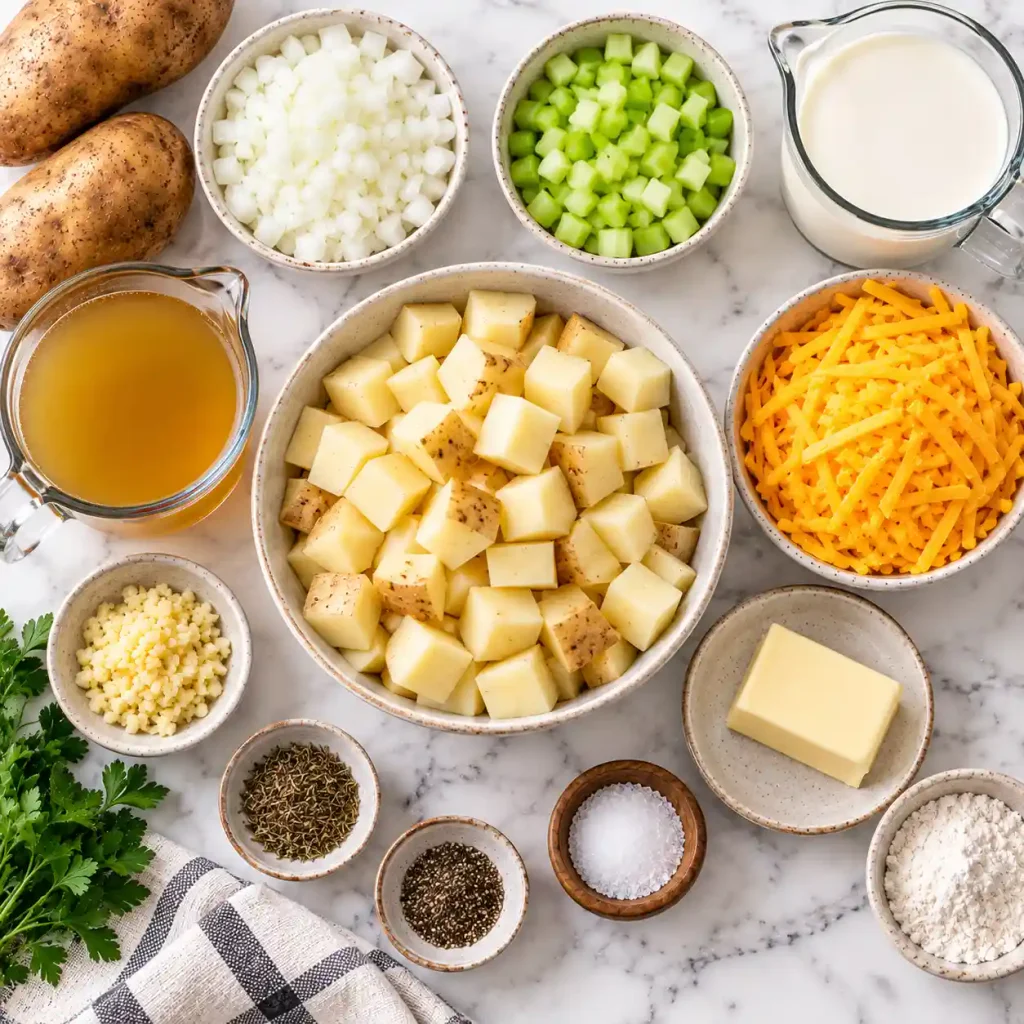
- 2 lbs russet potatoes, peeled and cut into ¾-inch cubes (about 5 to 6 medium potatoes) — the starch in these breaks down naturally and thickens the broth as it cooks
- 3 tablespoons unsalted butter — builds a rich, rounded base flavor for the sauté
- 1 small yellow onion, diced
- 2 celery stalks, diced
- 3 garlic cloves, minced
- 4 cups low-sodium vegetable or chicken broth
- 1 bay leaf
- 1 cup whole milk
- ½ cup heavy cream — adds body at the end without needing a flour-based roux
- 1 teaspoon dried thyme
- Salt and black pepper, to taste
For topping:
- 1 cup shredded sharp cheddar
- ¼ cup sour cream
- 2 tablespoons chopped chives or green onion tops
- ⅓ cup crispy fried onions, store-bought or homemade — brings a salty crunch without any meat involved
Substitution note: for extra savory depth in the base itself, stir in a teaspoon of smoked paprika with the thyme.

Recipe Timing
The 15 minutes of prep covers peeling and cubing the potatoes and dicing the onion and celery while the butter melts in the pot. Once the broth goes in, the potatoes need a full 20 minutes at a gentle simmer to turn fork-tender, and the last 5 minutes are for stirring in the dairy and letting the soup come back to a light heat without boiling.
Allergen & Dietary Disclosure
This recipe contains dairy (butter, milk, cream, cheddar, sour cream). For a dairy-free version, swap the milk and cream for full-fat coconut milk, use a dairy-free cheddar shred, and cook the vegetables in olive oil instead of butter, though the flavor will shift slightly toward coconut. If anyone eating has a severe dairy allergy, double-check every packaged ingredient’s label yourself, since this recipe isn’t a guarantee of safety for any specific allergy.
Equipment Needed
- Dutch oven or heavy-bottomed pot: even heat distribution keeps the potatoes from scorching on the bottom while they simmer.
- Potato masher: used briefly at the end to break up about a third of the potatoes and thicken the broth without pureeing the whole pot.
- Wooden spoon: scrapes up the browned bits left from sautéing the vegetables, which carry a lot of flavor into the broth.
- Ladle: makes portioning even servings into bowls far less messy than pouring from the pot.
Read Also: Cheesy Breakfast Casserole
Preparation
Peel and cube the potatoes ahead of time and drop them into a bowl of cold water so they don’t brown while you work on the rest. Dice the onion and celery into similar-sized pieces so they cook at the same rate, and mince the garlic separately so it doesn’t go in too early and burn.
Step-by-Step Instructions
Step 1: Melt the butter and soften the vegetables Set a Dutch oven over medium heat and melt the butter until it foams slightly, then add the diced onion and celery. Cook for 5 to 6 minutes, stirring now and then, until the onion turns translucent and the celery loses its raw bite.
Step 2: Add the garlic Stir in the minced garlic and cook for another 30 seconds, just until it smells fragrant, taking care not to let it brown or turn bitter.
Step 3: Build the broth Pour in the broth and scrape the bottom of the pot with a wooden spoon to lift up any browned bits stuck there. Add the cubed potatoes, bay leaf, and dried thyme, then raise the heat until the liquid reaches a steady simmer.
Step 4: Simmer until tender Lower the heat slightly to keep a gentle simmer going and cook uncovered for 18 to 20 minutes, until a fork slides into the potato cubes with almost no resistance. Fish out the bay leaf and discard it.
Chef’s Note: a rolling boil here breaks the potato cubes apart unevenly and can leave the broth gritty, so keep the heat at a level bubble instead.
Step 5: Thicken the base Press a potato masher into the pot 8 to 10 times, mashing roughly a third of the potato cubes while leaving the rest whole. This releases extra starch straight into the broth and thickens it without any flour.
Step 6: Add the dairy Turn the heat down to low, then stir in the whole milk and heavy cream. Warm the soup gently for 3 to 4 minutes, stirring often, until it’s heated through but never lets a full bubble break the surface.
Chef’s Note: dairy added over high heat is the main reason potato soup separates into a grainy mess, so patience here matters more than speed.
Step 7: Season and finish Taste the soup and season with salt and black pepper, keeping in mind the cheese and crispy onions still to come will add more salt on their own. Stir in half of the shredded cheddar until it melts smoothly into the broth.
Chef’s Note: melting the cheese directly into the broth, instead of only sprinkling it on top, is what gives every spoonful that same cheesy pull instead of just the first bite.
[AI IMAGE PROMPT: Close-up 45-degree shot of potato soup simmering in a Dutch oven, wooden spoon stirring, visible potato chunks and creamy golden broth, steam rising, dark wood table, warm side lighting, cast iron pot] [IMAGE PLACEHOLDER — alt-text: “Potato soup simmering in a Dutch oven with a wooden spoon” | filename: “potato-soup-simmering-dutch-oven.jpg” | orientation: horizontal]
Step 8: Ladle and top Spoon the soup into bowls and finish each one with the remaining cheddar, a spoonful of sour cream, a handful of crispy fried onions, and a scatter of chopped chives.
Read Also: Buffalo Chicken Dip
Expert Tips & Tricks
- Cube the potatoes evenly. The first time I made this, half my potato chunks were double the size of the others, and the small pieces turned to mush while the big ones stayed firm. Even cubes cook at the same rate.
- Make the base a day ahead. The soup base (through Step 5) actually tastes better the next day once the flavors settle, so you can hold it in the fridge and stir in the dairy fresh right before serving.
- Freeze before the dairy goes in. Cream-based soups can separate in the freezer, so freeze the base only and add milk and cream after it’s thawed and reheated.
- Warm the milk first for a smoother finish. Letting cold milk sit out for 10 minutes before adding it keeps the temperature shock from the pot from causing any grainy texture.
- Reserve some potato water instead of tossing it. If the soup thickens too much after resting, a splash of the starchy cooking liquid loosens it back up without watering down the flavor.
- Toast the crispy onions separately, right before serving. Adding them too early lets them go soft in the steam, so keep them in a bowl on the side until the very last step.
Common Mistakes & Troubleshooting
| Problem | Why It Happens | How to Fix or Prevent It |
| Soup turns grainy or separates | Dairy was added over high heat or boiled afterward | Lower the heat to a bare simmer before stirring in milk and cream, and never let it boil again |
| Broth stays thin and watery | Not enough potato starch released into the liquid | Mash a larger portion of the potatoes, or stir in one extra cubed potato and simmer 5 more minutes |
| Potatoes fall apart into mush | Cut too small or simmered at a rolling boil | Cut cubes at ¾ inch and keep the heat at a gentle simmer, not a hard boil |
| Soup tastes flat | Salt was added too early, before the salty toppings | Season lightly during cooking and adjust again after the cheese is stirred in |
| Cheese clumps instead of melting smooth | Cheese was added while the broth was too hot or too cold | Bring the soup down to a low simmer first, then stir cheese in gradually, a handful at a time |
Storage, Reheating, Freezing, Make-Ahead
Refrigerator: Store leftovers in an airtight container for up to 4 days. The soup thickens further as it chills, which is normal.
Freezer: Freeze the base without the dairy or cheese in a freezer-safe container for up to 2 months. Thaw overnight in the fridge before reheating and adding the milk and cream.
Reheating: Warm gently on the stovetop over low heat, stirring often, and add a splash of broth or milk if it’s thickened more than you’d like. Avoid the microwave on high power, since it tends to overheat the edges before the center catches up.
Make-Ahead: The base holds well in the fridge for a day before you finish it with dairy, which is genuinely the easiest way to get ahead on a weeknight dinner.
My own habit is labeling containers with the date and “add cream” written right on the lid, since it’s easy to forget which batch still needs the dairy stirred in.

Variations & Substitutions
- Loaded baked potato style: top with extra cheddar, sour cream, and a heavier scatter of crispy fried onions, mimicking the toppings on a classic loaded baked potato.
- Spicy kick: stir in a diced jalapeño with the onion and celery, or finish each bowl with a dash of hot sauce.
- Kid-friendly and mild: skip the pepper and thyme, and stick to just cheddar and a little sour cream on top for a gentler flavor.
- Extra vegetables: stir in a cup of small-diced carrots with the onion and celery for natural sweetness and more color in the broth.
- Lighter version: swap the heavy cream for additional whole milk or a splash of half-and-half, which trims some richness while keeping the soup creamy.
Serving Suggestions
- A warm loaf of crusty bread or dinner rolls for scooping up the last bit of broth
- A simple green salad with a light vinaigrette to balance the richness
- [INTERNAL LINK: garlic butter dinner rolls recipe]
- A side of roasted broccoli or green beans for extra vegetables
- Extra shredded cheddar and crispy fried onions set out so everyone can top their own bowl
- [INTERNAL LINK: classic cornbread recipe]
Nutrition Information
Nutrition values are estimates only and will shift depending on specific brands and how ingredients are measured.
Serving size: 1 ½ cups | Servings per recipe: 6
| Nutrient | Amount |
| Calories | 355 |
| Protein | 10g |
| Carbohydrates | 34g |
| Fiber | 3g |
| Sugar | 6g |
| Fat | 20g |
| Saturated Fat | 12g |
| Cholesterol | 55mg |
| Sodium | 480mg |
This bowl also carries a solid amount of potassium and vitamin C from the potatoes themselves, both of which take a hit if potatoes are boiled and drained rather than simmered directly in the broth the way this recipe does it.
Why This Recipe Works
Russet potatoes carry more starch than waxy varieties, and that starch leaks into the surrounding liquid as the potatoes simmer. Mashing a portion of the cooked cubes speeds that process along, giving the broth its body without any flour or cornstarch stirred in separately.
Adding the dairy at the end, once the heat has dropped to a gentle simmer, keeps the proteins in the milk and cream from tightening up too fast. That sudden tightening is what causes a grainy or curdled texture, so timing the dairy step matters as much as the ingredients themselves.
Cooking the onion and celery in butter first builds a rich, rounded base flavor into the broth before the liquid ever goes in, so every spoonful carries that depth instead of relying only on the toppings for flavor.
Read Also: Easy White Chicken Chili
Frequently Asked Questions
FAQ Source Note: the questions below reflect common search patterns and typical reader questions around potato soup, based on general knowledge of frequent cooking concerns rather than a specific live search.
Can I make potato soup ahead of time?
Yes, the soup base holds up well in the fridge for up to a day before you stir in the dairy. Keep the milk and cream separate until you’re ready to reheat and serve, since adding them early and then reheating twice raises the risk of the soup separating.
Why did my potato soup turn out grainy?
Grainy texture almost always comes from the dairy being added over heat that’s too high, or from the soup boiling after the cream goes in. Bring the pot down to a low simmer first, stir in the milk and cream gradually, and keep the heat gentle from that point on.
Can I use a different potato variety?
Yukon gold potatoes work in a pinch and give a slightly buttery flavor, but they carry less starch than russets, so the broth won’t thicken as much on its own. If you use Yukon golds, mash a slightly larger portion of the cooked potatoes to make up the difference.
How do I know when the potatoes are fully cooked?
A fork should slide into a potato cube with almost no resistance, usually around the 18 to 20 minute mark at a gentle simmer. If there’s still a firm center, give it another 3 to 4 minutes rather than raising the heat.
Is this potato soup gluten-free?
Yes, as written this recipe doesn’t use any flour or wheat-based thickener, since the broth thickens from the potato starch itself. Just double-check that your broth and crispy fried onions are labeled gluten-free, since some brands add fillers.
Can I make this potato soup dairy-free?
Swap the butter for olive oil, the whole milk and heavy cream for full-fat coconut milk in equal amounts, and use a dairy-free cheddar shred for topping. The flavor shifts slightly, picking up a light coconut note, but the texture stays creamy.
What toppings work best on potato soup?
Shredded cheddar, sour cream, crispy fried onions, and chopped chives are the classic combination, and they’re listed in the ingredients above for exactly that reason. Beyond that, a few croutons or a drizzle of hot sauce both work well if you want to switch it up.

Conclusion
This is the potato soup I go back to on the first genuinely cold night of the year, mostly because it doesn’t ask for much beyond a pot and 40 minutes. The mashed-in potato starch does the real work here, so you get a thick, spoon-coating broth without ever reaching for flour.
If you end up with leftovers, they hold in the fridge better than most creamy soups do, which makes this one just as good the second night as it is fresh off the stove. However you top your bowl, this potato soup recipe is built to be simple enough for a Tuesday and good enough for company.
If you loved this recipe, save it to your Soups & Stews Pinterest board so you can find it easily later!

Creamy Potato Soup
Ingredients
Method
- Instructions:
- Melt the butter in a Dutch oven over medium heat, then cook the onion and celery for 5 to 6 minutes until softened.
- Stir in the garlic and cook for 30 seconds until fragrant.
- Pour in the broth, scrape up any browned bits, and add the potatoes, bay leaf, and thyme. Bring to a simmer.
- Simmer uncovered 18 to 20 minutes until the potatoes are fork-tender, then remove the bay leaf.
- Mash about a third of the potatoes directly in the pot to thicken the broth.
- Lower the heat and stir in the milk and cream, warming gently for 3 to 4 minutes without boiling.
- Season with salt and pepper, then stir in half the cheddar until melted.
- Serve topped with the remaining cheddar, sour cream, crispy fried onions, and chives.
Notes
- Freeze the base only, before adding dairy, for up to 2 months.
- Reheat gently over low heat and thin with a splash of broth or milk if needed.
- Swap Yukon gold potatoes in a pinch, mashing a bit more to compensate for lower starch.
- For dairy-free, use olive oil, coconut milk, and a dairy-free cheddar shred.