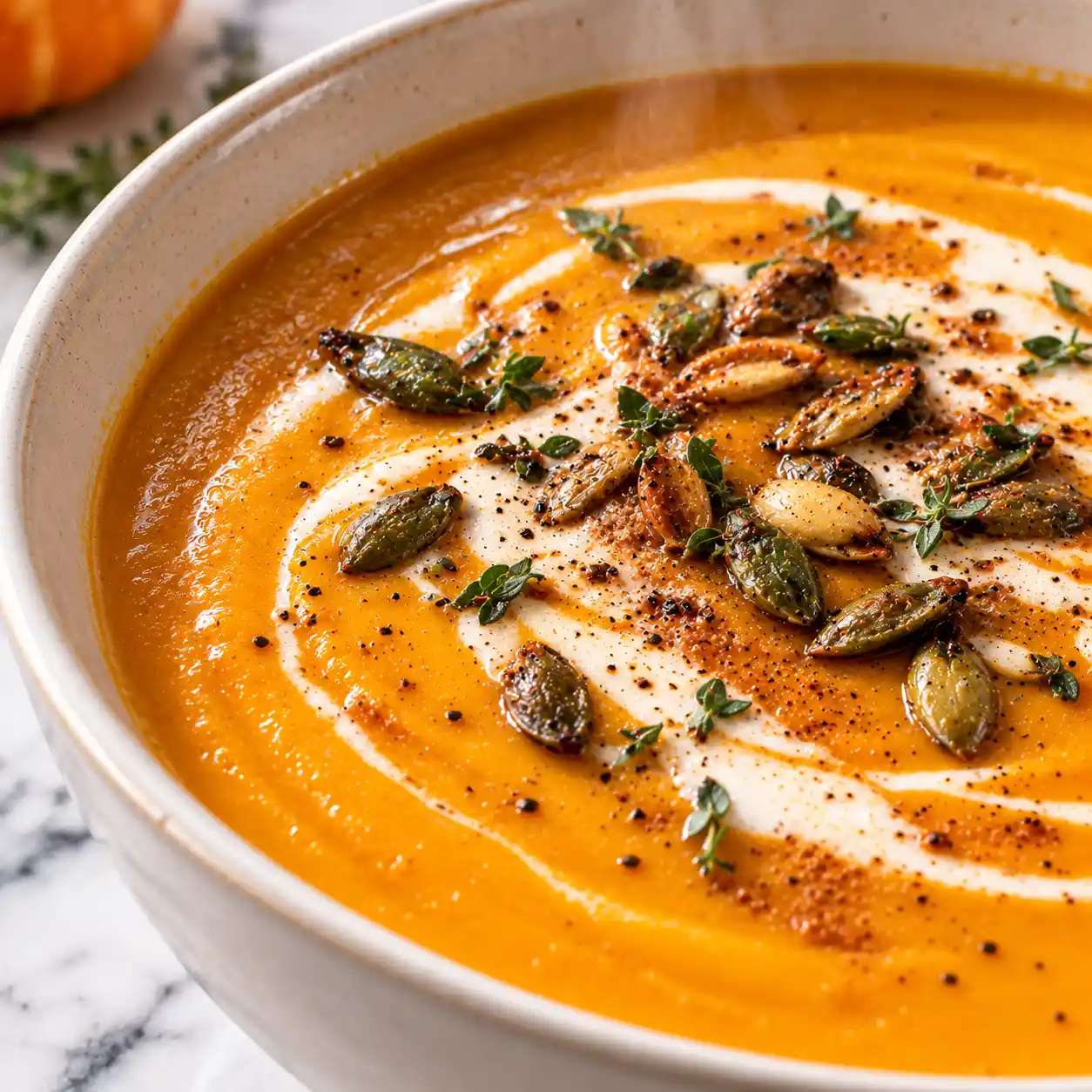
Foolproof Butternut Squash Soup: 7 Ingredients, 50 Minutes

A good bowl of butternut squash soup should taste like an autumn evening with the heating on: sweet, toasty, a little savory, and thick enough to coat your spoon. This one gets there with a hands off roast and one short simmer.
You need 7 ingredients plus salt and pepper, and the whole pot is ready in 50 minutes. The trick is roasting the squash, onion, and garlic together on one sheet pan so they caramelize before they ever meet the broth. That browning gives the soup a depth most quick versions lack. An immersion blender finishes the job right in the pot, so you end up with one pan, one blender, and very little to wash. Beginners can handle it, and it doubles easily for a crowd or a week of lunches.
Why You’ll Love This Butternut Squash Soup
- One sheet pan does the flavor work. Roasting the vegetables together browns them evenly, so you skip the stirring and sautéing.
- No flour or potato needed. The squash itself turns silky when blended, which keeps the soup naturally thick.
- Short ingredient list. You likely have the onion, garlic, oil, and broth already, so shopping is mostly one squash and a small carton of cream.
- Freezer friendly. A full batch makes six servings, and portions freeze well for busy nights.
- Easy to adjust. Smoky, spicy, dairy free, or mild for kids all work with a small swap listed below.
Ingredient Selection Tips
Pick a butternut squash that feels heavy for its size, with matte, evenly tan skin and no soft spots, cuts, or shiny patches. A long neck and a small round bulb give you more usable flesh and fewer seeds. Skip any squash with a dried, cracked stem or damp, mushy areas near the base. Short on time? A bag of precut cubes works fine, but check that the pieces look moist and orange, not dry or fuzzy at the edges. For broth, choose a low sodium vegetable broth so you control the salt. [INTERNAL LINK: how to pick and cut winter squash]
Recipe Snapshot
| Detail | Value |
| Servings | 6 |
| Difficulty | Easy |
| Course | Soup |
| Cuisine | American |
| Prep Time | 15 minutes |
| Cook Time | 35 minutes |
| Total Time | 50 minutes |
| Calories | 215 per serving |
Ingredients
For the roasted base:
- 1 large butternut squash (about 2.5 pounds or 1.1 kg), peeled, seeded, and cut into 3/4 inch cubes (about 6 cups). Squash is the body of the soup, so a fully ripe one means sweeter flavor.
- 1 large yellow onion, cut into 8 wedges. Onion turns jammy in the oven and adds savory balance to the sweet squash.
- 4 garlic cloves, peeled. Roasting mellows garlic into something nutty, so it will not taste sharp.
- 3 tablespoons olive oil. The oil helps the edges brown and carries flavor through the soup.
- 1 1/4 teaspoons fine salt, divided
- 1/2 teaspoon black pepper
For the soup:
- 4 cups (960 ml) low sodium vegetable broth. A mild broth keeps the squash flavor in front. Watch for strong tomato or herb heavy brands.
- 1/2 cup (120 ml) heavy cream. This rounds out the texture and softens the squash’s natural sweetness. Full fat coconut milk works as a swap with a slightly sweeter finish.
- 1/4 teaspoon ground nutmeg. A small amount adds warmth without tasting like a spice.
Optional garnish: toasted pumpkin seeds, a drizzle of cream, cracked pepper.
[AI IMAGE PROMPT: Fresh ingredients for butternut squash soup arranged on a white marble surface: peeled orange squash cubes in a white ceramic dish, yellow onion wedges, garlic cloves, glossy olive oil in a glass cruet, cream in a small glass pitcher, soft natural daylight, top down flat lay.]
[IMAGE PLACEHOLDER — alt-text: “Flat lay of butternut squash cubes, onion, garlic, olive oil, and cream on white marble” | filename: “butternut-squash-soup-ingredients-flat-lay.jpg” | orientation: horizontal]
Recipe Timing
Plan on about 15 minutes for peeling and cutting, and you can heat the oven during that time. The roast takes 25 minutes, and the pot work after that adds roughly 10 more: a 6 minute simmer, a couple of minutes of blending, and a quick warm through with the cream. That brings you to 50 minutes from the first cut to the first spoonful. Precut squash trims around 10 minutes off the prep.
Allergen and Dietary Notes
- Dairy: The heavy cream contains milk. Swap in an equal amount of full fat coconut milk to make it dairy free.
- Gluten, celery, or soy: Some vegetable broths include these, so read the label if you cook for someone with a sensitivity.
Anyone with a severe allergy should check every ingredient label and talk to a doctor before serving this soup.
Read Also:
Equipment Needed
- Immersion blender: Blending in the pot saves transferring hot soup. A countertop blender also works if you fill it halfway and vent the lid.
- Y peeler: Squash skin is tough, and a Y peeler glides through it faster than a swivel peeler.
- Large rimmed sheet pan: Spread the vegetables in a single layer so they roast instead of steam. Use two pans if they overlap.
- Dutch oven or 4 quart pot: A heavy pot holds heat steadily for the simmer and gives the blender room to work.
- Sharp chef’s knife: A dull blade slips on squash. Rest the cutting board on a damp towel so it stays put.
Preparation
Heat the oven to 425°F (220°C) and slide a rack into the center. Trim both ends off the squash, then cut the neck from the round bulb so you have two stable pieces. Peel each piece, halve the bulb, scoop out the seeds, and cut everything into 3/4 inch cubes. Even sizes matter, because small pieces burn while big ones stay firm.
Callout: If the squash is hard to cut, pierce the skin in a few places and microwave it for 2 minutes. The skin softens just enough to make peeling and slicing much easier.
Cut the onion into wedges and peel the garlic. Place the vegetables on your sheet pan, drizzle with olive oil, and add 3/4 teaspoon of the salt and all the pepper.
Step by Step Instructions
Step 1: Load the pan
Toss the squash, onion, and garlic with the oil, salt, and pepper using your hands until every piece looks glossy. Spread them in a single layer with a little space between pieces.
Step 2: Roast the vegetables
Roast at 425°F (220°C) for 25 minutes, stirring once at the halfway point. The squash is ready when a fork slides in with no resistance and the edges show deep amber spots.
Chef’s Note: Dry oven heat browns the sugars in squash and onion, which creates flavor that boiling alone cannot reach.
[AI IMAGE PROMPT: Caramelized butternut squash cubes and onion wedges roasting on a light aluminum rimmed baking sheet, edges deeply browned and glistening with olive oil, whole garlic cloves tucked between, placed on a white marble counter, warm kitchen light, 45 degree food photography angle.]
[IMAGE PLACEHOLDER — alt-text: “Roasted butternut squash and onion on a baking sheet with browned edges” | filename: “roasted-butternut-squash-onion-garlic.jpg” | orientation: horizontal]
Step 3: Warm the broth
During the last 5 minutes of roasting, pour the broth into a Dutch oven over medium heat. Wait for steam and tiny bubbles around the edge, then lower the heat.
Step 4: Combine and simmer
Tip the roasted vegetables into the broth. Pour a splash of hot broth onto the empty pan and scrape up the browned bits, then add them to the pot. Simmer for 6 minutes.
Chef’s Note: Those browned bits on the sheet pan hold concentrated flavor, so scraping them into the pot makes the soup taste richer.
Step 5: Blend until smooth
Turn off the heat. Blend with an immersion blender for 1 to 2 minutes, moving it slowly until no flecks remain and the soup looks smooth and glossy.
Chef’s Note: Keep the blade fully submerged and tilt the pot slightly to avoid hot splashes, and blend a little longer than feels necessary for a truly silky texture.
[AI IMAGE PROMPT: Immersion blender with a stainless steel shaft puréeing roasted squash into smooth orange soup inside a white enameled Dutch oven, thick glossy swirls, steam rising, side lit for texture, white marble surface beneath, warm kitchen light, eye level camera angle.]
[IMAGE PLACEHOLDER — alt-text: “Immersion blender puréeing roasted squash soup in a white Dutch oven” | filename: “blending-butternut-squash-soup-immersion-blender.jpg” | orientation: horizontal]
Step 6: Add cream and nutmeg
Return the pot to low heat. Stir in the cream and nutmeg, then warm for 2 minutes without letting it boil, so the cream stays smooth.
Step 7: Taste and adjust
Stir in the remaining 1/2 teaspoon salt, taste, and add more if needed. If the soup feels too thick, stir in 1/4 cup broth or water until it runs off a spoon in a steady ribbon.
Step 8: Serve
Ladle the hot soup into warm bowls. Drizzle a little cream across the top and finish with cracked pepper and pumpkin seeds.
[AI IMAGE PROMPT: Heavy cream being drizzled in a thin ribbon over orange butternut squash soup in a wide white ceramic bowl, creamy swirl forming a pale spiral, steam rising, white marble table, warm kitchen light, top down camera angle, sprinkle of black pepper.]
[IMAGE PLACEHOLDER — alt-text: “Cream drizzled over butternut squash soup in a white bowl” | filename: “cream-swirl-butternut-squash-soup.jpg” | orientation: horizontal]
Read Also:
Expert Tips and Tricks
- Cut evenly. Pieces of the same size finish at the same moment, so nothing stays hard or turns bitter.
- Give the pan room. Crowded vegetables steam in their own moisture and stay pale. Use a second pan if they touch.
- Blend longer than you think. Another 30 seconds removes tiny fibers and makes the soup noticeably smoother.
- A mistake I made once: I filled a countertop blender to the top with hot soup and sealed the lid tight. The steam pushed it open and covered the counter. Fill it halfway and vent the lid with a towel.
- Make ahead: Roast the vegetables up to 2 days early and refrigerate them. On serving day, simmer and blend as usual.
- Storage tip: Leave the cream out of any portion you plan to freeze, then stir it in after reheating.
- Save time: Precut squash and an immersion blender cut roughly 10 minutes and one dish from the process. For more roasting ideas, see [INTERNAL LINK: how to roast vegetables guide].
Common Mistakes and Troubleshooting
| Problem | Why It Happens | How to Fix or Prevent It |
| Soup tastes flat | Vegetables steamed instead of browned | Spread them out and roast until the edges are deep amber |
| Stringy or gritty texture | Blended too briefly or squash undercooked | Roast until fork tender and blend for a full 2 minutes |
| Too thin and watery | Extra broth or a small squash | Simmer 5 more minutes uncovered, or reduce the broth next time |
| Too thick | Squash was dense or soup cooled | Stir in warm broth a splash at a time |
| Bitter garlic taste | Garlic burned on the pan | Tuck cloves between squash pieces, away from the pan edge |
| Cream curdled | Soup boiled after adding cream | Warm gently on low heat and stop before bubbles form |
I once let the garlic sit on the outer edge of a hot pan and it scorched, which made the whole pot taste slightly bitter. Keeping it in the middle of the pan fixed that.
Storage, Reheating, Freezing, and Make Ahead
Refrigerator: Cool the soup, then store it in an airtight container for up to 4 days.
Freezer: Freeze cream free soup in freezer safe containers for up to 3 months, leaving 1 inch of space at the top for expansion.
Reheating: Warm gently on the stove over medium low heat, stirring often, and add a splash of broth if it has thickened. In the microwave, heat in 90 second bursts, stirring between each.
Make ahead: Roast the vegetables 2 days early, or make the whole soup 1 day ahead and add the cream when reheating.
Callout: Freeze portions flat in zip top bags. They thaw faster and stack neatly in the freezer.
[AI IMAGE PROMPT: Four glass storage jars of orange butternut squash soup lined up on a white marble surface, three sealed with white lids and labeled tags, one open to show the glossy smooth surface, soft natural daylight, 45 degree food photography angle.]
[IMAGE PLACEHOLDER — alt-text: “Glass jars of butternut squash soup labeled for storage” | filename: “storing-butternut-squash-soup-glass-jars.jpg” | orientation: horizontal]
Variations and Substitutions
- Spicy: Add 1/4 teaspoon cayenne and 1 teaspoon ground cumin to the pan before roasting.
- Dairy free and vegan: Use full fat coconut milk in place of the cream, and check that your broth is plant based.
- Curry style: Roast the squash with 1 tablespoon mild curry powder and a teaspoon of grated ginger for a warmer, aromatic soup.
- Apple twist: Add 1 peeled, chopped apple to the pan for a lighter, fruity sweetness.
- Mild and kid friendly: Skip the pepper and nutmeg, and use a little extra cream for a gentler flavor.
- Gluten free: The recipe is naturally gluten free when your broth is, so confirm the label.
Serving Suggestions
- Serve with a warm slice of crusty bread for dipping. [INTERNAL LINK: homemade crusty bread recipe]
- Pair with a crisp salad of greens, apple, and walnuts for contrast. [INTERNAL LINK: simple autumn salad recipe]
- Top with toasted pumpkin seeds, croutons, or a spoonful of plain yogurt.
- Finish with a drizzle of cream or a few drops of olive oil.
- Offer sparkling water with lemon or warm spiced tea alongside.
- Turn it into a meal with a grilled cheese sandwich on the side.
Nutrition Information
Serving size: about 1 1/3 cups | Servings per recipe: 6
| Nutrient | Amount |
| Calories | 215 |
| Protein | 3 g |
| Carbohydrates | 21 g |
| Fiber | 4 g |
| Sugar | 5 g |
| Fat | 14 g |
| Saturated Fat | 6 g |
| Cholesterol | 27 mg |
| Sodium | 590 mg |
Butternut squash is a rich source of vitamin A and also supplies vitamin C and potassium. These numbers are estimates and shift with brand choices and how you measure ingredients.
Why This Recipe Works
Roasting does what simmering cannot. At 425°F, the natural sugars in the squash and onion brown, which adds toasty, savory notes on top of the sweetness. Boiling the same vegetables would give a soup that tastes plain by comparison.
The blending step does the thickening. Squash holds a lot of starch and fiber, and when it is puréed with hot broth, those particles swell and make a silky body without flour or potato. Cooking the squash until completely soft keeps that body smooth instead of grainy.
Cream goes in last and stays below a boil. Heat that is too high can make dairy separate, so a gentle warm through keeps the soup glossy.
Read Also:
Frequently Asked Questions
FAQ source note: These questions follow common patterns seen in typical People Also Ask and recipe search queries. They were not pulled from live search.
Can I make butternut squash soup ahead of time?
Yes. The soup keeps in the refrigerator for 4 days and tastes even better the next day as the flavors settle. Cool it first, then store it in an airtight container. For longer storage, freeze it without the cream for up to 3 months, then reheat on the stove and stir in the cream at the end.
Why is my butternut squash soup stringy?
Stringy soup usually means the squash was not fully tender or the blending was too short. Roast until a fork slides in with no resistance, then blend for a full 2 minutes. If you still see fibers, run the soup through a fine mesh strainer for a restaurant smooth finish.
What can I use instead of heavy cream?
Full fat coconut milk is the easiest swap and gives a slightly sweeter result. You can also use half and half for a lighter soup, or cashew cream for a neutral flavor. Add any replacement at the end over low heat so it blends in smoothly.
How do I know when the squash is roasted enough?
Look for deep amber spots on the edges and test with a fork. It should slide through the thickest cube without any push. If the center still feels firm, roast another 5 minutes. Cubes cut to 3/4 inch usually finish in 25 minutes at 425°F.
Is butternut squash soup dairy free?
Not as written, since the recipe uses heavy cream. To make this butternut squash soup dairy free, replace the cream with full fat coconut milk and use olive oil, which is already in the recipe. Read the broth label too, since some brands contain milk based ingredients.
Can I use a regular blender?
Yes. Let the soup cool for a few minutes, fill the blender only halfway, and vent the lid with a folded towel on top. Blend in batches until smooth. This is the safest way to handle hot liquid, because trapped steam can push the lid off.
[AI IMAGE PROMPT: A deep white ceramic bowl of velvety butternut squash soup with a cream swirl, toasted pumpkin seeds, and fresh cracked pepper, a slice of crusty bread beside it, white marble surface, soft natural daylight, eye level angle, glossy and steaming.]
[IMAGE PLACEHOLDER — alt-text: “Bowl of creamy butternut squash soup with pumpkin seeds and crusty bread” | filename: “butternut-squash-soup-final-plated-shot.jpg” | orientation: vertical]
Conclusion
The best thing about this pot is how little it asks of you. Once the pan is in the oven, you have 25 free minutes, and the only real skill is waiting for deep amber edges on the squash. That wait is what makes the soup taste like more than its short ingredient list.
I make this butternut squash soup whenever the weather turns, and it works for a quiet dinner or a big pot for guests. Keep a few portions in the freezer and you always have a warm meal ready.
If you loved this recipe, save it to your Butternut Squash Soup Pinterest board so you can find it easily later!
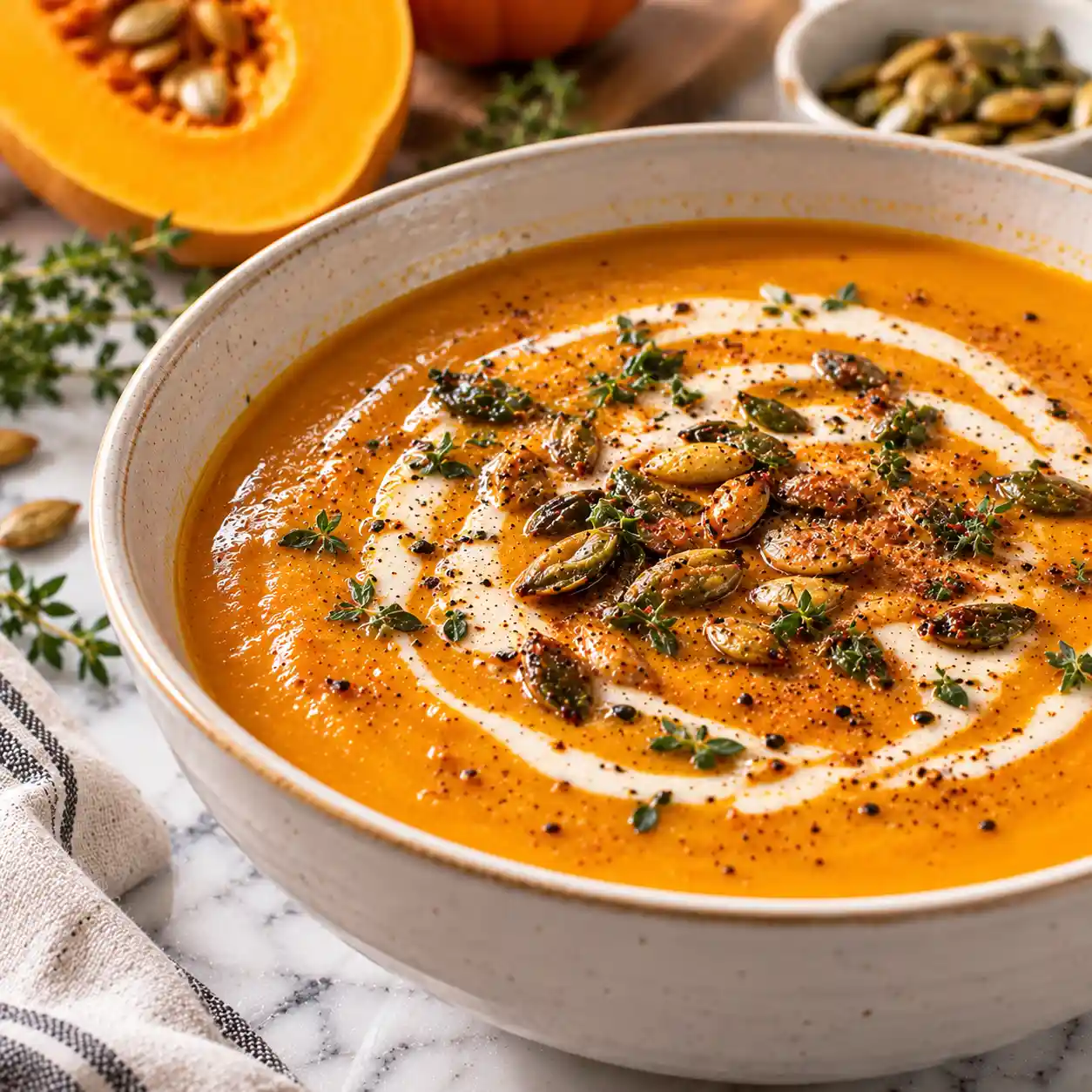
Foolproof Butternut Squash Soup
Ingredients
Method
- Instructions:
- Set the oven to 425°F (220°C). On a large rimmed sheet pan, coat the squash, onion, and garlic in the oil, 3/4 teaspoon salt, and the pepper, then spread into one layer.
- Roast for 25 minutes, turning everything once midway. The squash should yield easily to a fork and show dark amber edges.
- In the last 5 minutes of roasting, bring the broth in a Dutch oven to a gentle steam over medium heat.
- Transfer the roasted vegetables into the broth, loosen the browned bits from the pan with a splash of hot broth, and pour that in too. Simmer 6 minutes.
- Remove from heat and purée with an immersion blender for 1 to 2 minutes, until completely smooth.
- Place back over low heat, pour in the cream and nutmeg, and warm for 2 minutes without bubbling.
- Season with the remaining salt. Add broth or water by the splash if you want it thinner.
- Serve in warm bowls with a cream drizzle and optional pumpkin seeds.
Notes
- Store in the refrigerator for up to 4 days in an airtight container.
- Freeze without cream for up to 3 months, then add cream after reheating.
- For a dairy free version, use full fat coconut milk instead of cream.
- Precut squash saves about 10 minutes of prep.