Irresistible Cheesy Breakfast Casserole That Feeds 8 People

By the time the timer goes off, the whole house already smells like toasted bread, warm butter, and something savory crisping at the edges. People wander into the kitchen without being called. A good breakfast casserole creates that scene on its own, and it asks very little of you while it does.
This breakfast casserole takes 75 minutes from first chop to first slice, and that includes a short rest so the custard can finish setting. You can also build it the night before and bake it cold in the morning. Soft bread cubes soak up a seasoned egg mixture, chicken sausage adds savory depth without leaving a greasy pool behind, and sharp cheddar bakes into a lightly crisp top. Everything happens in one skillet and one dish, which keeps cleanup short and the morning calm. It slices cleanly, reheats well, and feeds eight people without a second thought.

Why You’ll Love This Breakfast Casserole
- Ready for busy mornings: Assemble it up to 12 hours ahead and bake straight from the fridge, so the morning job is just turning on the oven.
- One skillet, one dish: You brown the filling in a single pan and bake in a 9×13 dish, which leaves very little to wash.
- Feeds a crowd: Eight generous squares cover a family breakfast or a small brunch table, with a few left for tomorrow.
- Pantry friendly ingredients: Bread, eggs, milk, and cheese are already in most kitchens, so a store run is rarely needed.
- A texture that holds together: The custard ratio sets soft and sliceable instead of soggy or rubbery.
- Reheats cleanly: Single squares warm up in the oven or microwave and still taste fresh.
Ingredient Selection Tips
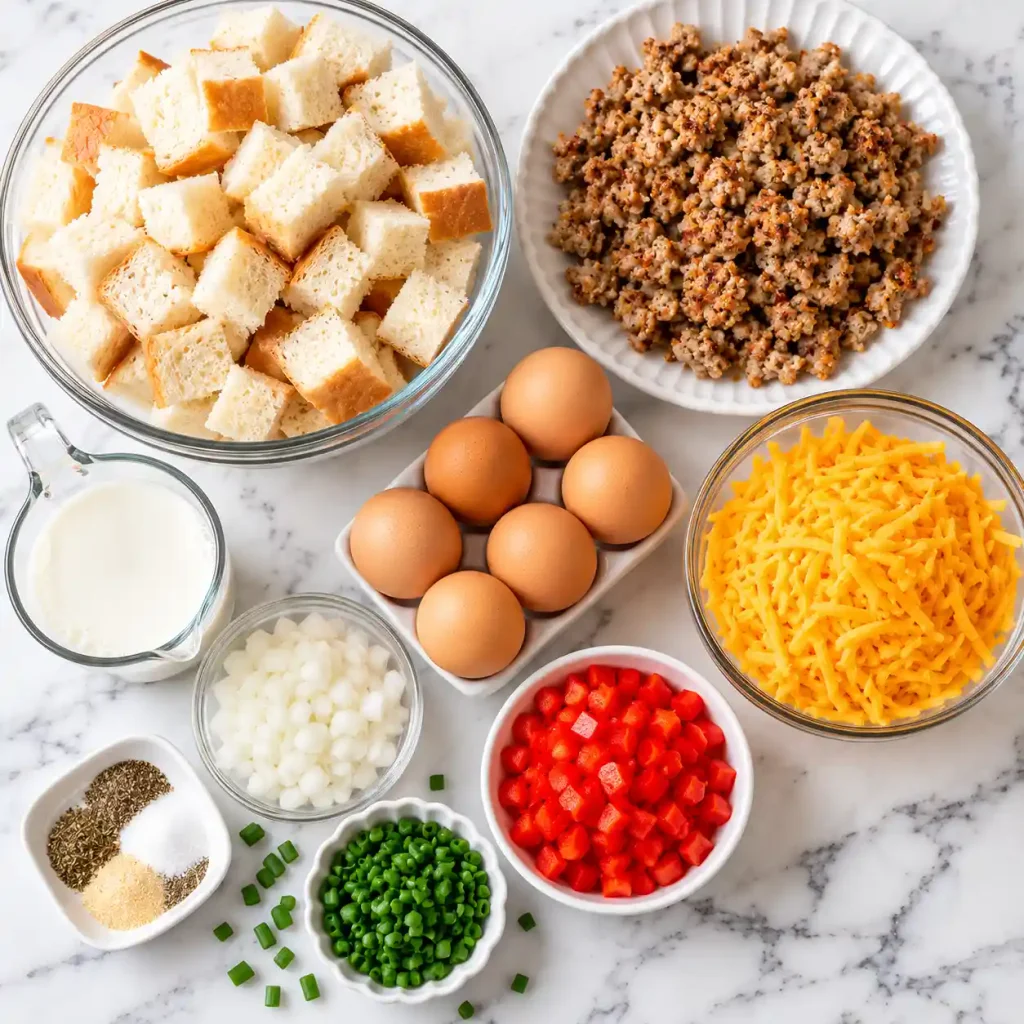
Bread matters more than anything else here. Pick a sturdy loaf such as a country white, French bread, or thick sandwich bread, and let it sit out for a day or two so the crumb dries. Thin, soft sliced bread turns to paste. For the sausage, look for fresh bulk chicken breakfast sausage with visible herbs in it, and glance at the sodium on the label, since that number decides how much salt the custard needs. Buy cheddar as a block and shred it yourself. Bagged shreds are coated with anti caking starch that keeps them from melting as smoothly. Large eggs and whole milk give the richest, most even set.
Recipe Snapshot
| Servings | Difficulty | Course | Cuisine | Prep Time | Cook Time | Rest Time | Total Time | Calories |
| 8 squares | Easy | Breakfast | American | 15 minutes | 50 minutes | 10 minutes | 75 minutes | 530 kcal per serving |
Ingredients
For the filling:
- 1 tablespoon olive oil (helps the sausage brown instead of steam)
- 1 pound (450 g) chicken breakfast sausage, bulk or removed from casings (leaner than heavier sausage, so the bake stays savory without a greasy layer)
- 1 medium yellow onion, diced, about 1 cup (adds sweetness that balances the salty sausage)
- 1 red bell pepper, diced, about 1 cup (brings color and a gentle sweetness)
For the base:
- 8 cups (about 1 pound or 450 g) sturdy white bread cubes, 3/4 inch, a day or two old (dry crumb drinks up custard without collapsing)
- 1 tablespoon butter, for greasing the dish
- 2 cups (8 oz or 225 g) shredded sharp cheddar, divided (1 cup in the layers, 1 cup on top; sharp cheese keeps its flavor against the eggs)
For the custard:
- 10 large eggs
- 2 1/2 cups (600 ml) whole milk (the fat keeps the custard tender)
- 1 teaspoon Dijon mustard (adds tang and helps the custard stay smooth)
- 3/4 teaspoon kosher salt
- 1/2 teaspoon black pepper
- 1/2 teaspoon garlic powder
- 1/2 teaspoon smoked paprika (a light smoky note that makes the dish taste slow cooked)
To finish:
- 2 tablespoons chopped fresh chives
Substitution notes: 2% milk works but gives a slightly leaner custard. Gruyère or Monterey Jack can replace the cheddar. Green onion tops can stand in for chives.
Read Also:
Recipe Timing
Plan on 15 minutes at the counter for cubing bread, dicing vegetables, and whisking the custard. The stovetop work takes about 5 minutes, and the bake takes 45. The last 10 minutes of rest are worth respecting, because the center keeps firming while the dish sits. From the first chop to the first slice, you are looking at 75 minutes, which leaves room for a pot of coffee.
Allergen & Dietary Disclosure
This dish contains eggs, dairy (milk and cheese), and gluten (wheat bread). Some sausages and breads also contain soy.
- Eggs: No reliable swap exists here, because the eggs build the structure of the custard.
- Dairy: Unsweetened oat milk and a dairy free cheddar style shred work, though the set will be softer.
- Gluten: Use a sturdy gluten free sandwich loaf and dry the cubes well before layering.
If anyone at your table has a severe allergy, read every label, including the sausage and bread, and check with their doctor first. This recipe cannot be guaranteed safe for any specific allergy.
Equipment Needed
- 9×13 inch (3 quart) ceramic or glass baking dish: It heats evenly and gives straight sides for clean squares. A metal pan browns the bottom faster, so check it a few minutes early.
- 12 inch skillet: The wide surface lets the sausage brown instead of steaming in its own juices.
- Instant read thermometer: It is the only dependable way to confirm the center has reached 160°F.
- Box grater: Freshly shredded cheddar melts into a smoother, more even top.
- Serrated bread knife: It cuts clean cubes without crushing the crumb.
Preparation
Slide an oven rack to the center position and turn the oven on to 350°F (175°C). Rub the butter over the bottom and sides of the 9×13 dish. Cut the bread into 3/4 inch cubes. If the loaf is fresh, spread the cubes on a sheet pan and dry them in the heating oven for 10 minutes, then let them cool a few minutes. Dice the onion and pepper, shred the cheddar, chop the chives, and measure out the custard seasonings so the stovetop steps move quickly.
Step by Step Instructions
Step 1: Brown the sausage
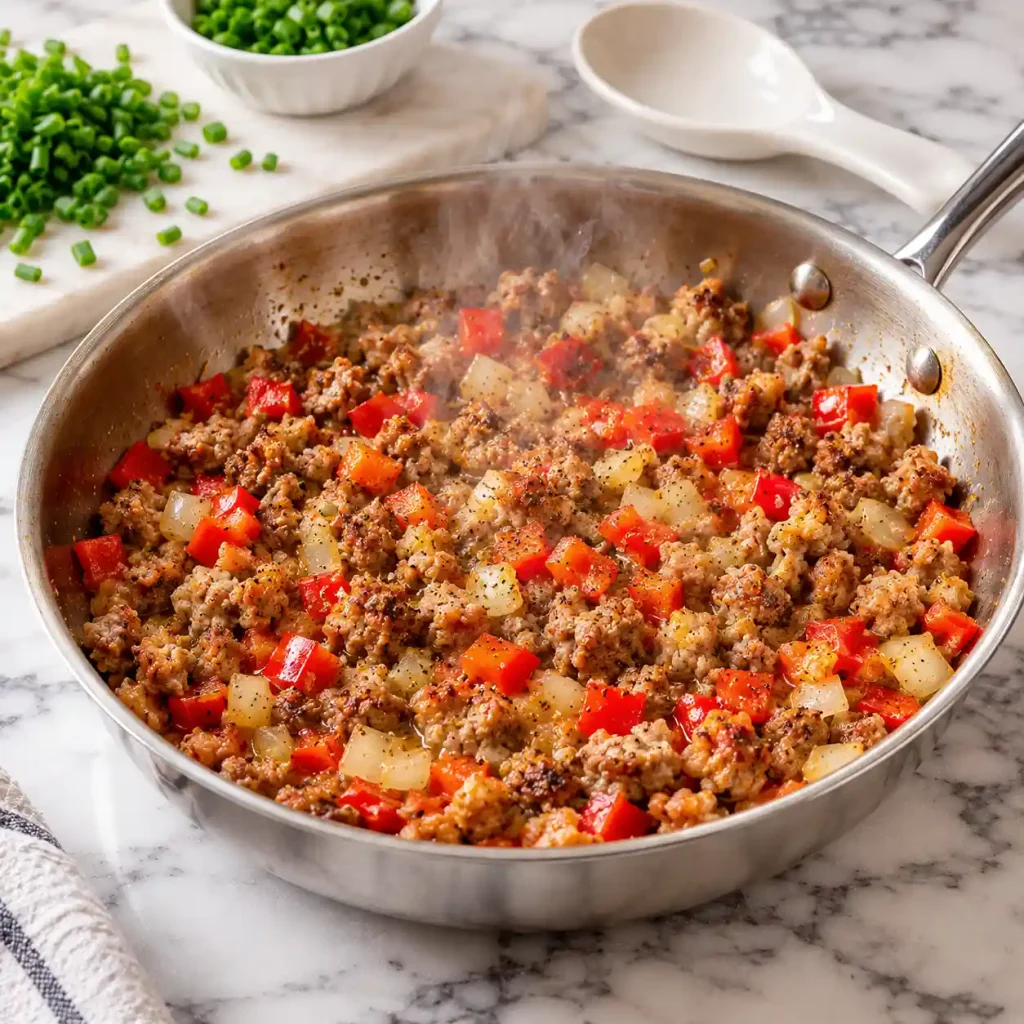
Warm the olive oil in a 12 inch skillet over medium high heat. Add the sausage and break it into small crumbles, then cook for about 3 minutes, until the meat is fully cooked through with no pink left. Wash your hands and any tools that touched the raw sausage before moving on.
Chef’s Note: Leave the crumbles untouched for the first 60 seconds. Direct contact with the hot pan builds browned bits, and those bits carry flavor the oven cannot add later.
Step 2: Soften the vegetables
Stir the onion and bell pepper into the skillet and cook for 2 minutes, until the onion looks glossy and the pepper has lost its raw crunch. Slide the pan off the heat and let the filling cool for a few minutes so it does not start cooking the eggs.
Step 3: Build the layers
Spread half of the bread cubes across the bottom of the buttered dish. Spoon the sausage mixture over them, scatter on 1 cup of the cheddar, then cover everything with the remaining bread.
Step 4: Whisk the custard
Crack the eggs into a big mixing bowl and add the milk, mustard, salt, pepper, garlic powder, and paprika. Whisk hard for a full minute, until the mixture turns pale yellow and no streaks of egg white remain.
Chef’s Note: The mustard is not there for a mustard taste. It adds a quiet tang and helps the milk and eggs blend into one smooth liquid.
Step 5: Pour and press
Pour the custard slowly and evenly across the dish, moving the bowl as you go. Press the top cubes down with a spatula so they dip into the liquid. Let the dish stand while the oven finishes heating if it still needs a minute.

Step 6: Top and bake
Sprinkle the last cup of cheddar over the surface. Bake on the center rack for 45 minutes, until the edges are puffed, the cheese is bubbling, and the top has taken on a light brown color. If the cheese darkens too much by minute 30, drape a sheet of foil over the dish.
Chef’s Note: Cheese on top shields the exposed bread cubes, which would otherwise dry into hard corners.
Step 7: Check the center
Slide an instant read thermometer into the middle of the dish. It should read 160°F (71°C), and a knife pushed into the center should come out with no runny egg. If the number is low, bake 5 more minutes and test again.
Chef’s Note: The puffed center will sink a little as it cools. That is normal and a sign the steam is escaping, not a sign of a problem.
Step 8: Rest and slice
Move the dish to a wire rack and leave it alone for 10 minutes. The custard finishes setting during that time, which is what lets the squares hold their shape. Cut 8 squares (2 across and 4 down) and top with the chives.

Read Also:
Expert Tips & Tricks
- Dry the bread properly: Soft bread is the main reason these dishes turn soggy. Even a 10 minute rest in a low oven makes fresh cubes behave like stale ones.
- My own mistake: I once poured the custard over a filling that was still steaming hot. The bottom layer set into scrambled bits instead of a smooth custard. Now I always let the skillet cool for a few minutes first.
- Make ahead: Cover the assembled dish tightly and refrigerate for up to 12 hours. Bake it cold, adding 5 to 10 minutes, and confirm the center reaches 160°F.
- Storage: Cool the baked squares fully, then stack them with a square of parchment between each layer so they never fuse together.
- Technique: If the sausage releases more than 2 tablespoons of fat, spoon off the extra before layering. Too much fat makes the base greasy.
- Time saving: A bag of frozen diced onion and pepper blend works well here. Cook it a minute longer to drive off the extra moisture.
Quick Tip: Whisk the custard in a bowl with a spout, or pour it from a large measuring pitcher. It lets you cover the corners evenly, and corners are where dry bread cubes usually hide.
Common Mistakes & Troubleshooting
| Problem | Why It Happens | How to Fix or Prevent It |
| Soggy bottom layer | Fresh or thin bread, too much milk, or pulling the dish before the center sets | Use sturdy dried bread, measure the milk, and bake until the center reads 160°F |
| Rubbery, weeping eggs | The dish baked too long or the oven ran hot | Bake at 350°F, pull at 160°F, and rest for 10 minutes |
| Bland flavor | Unseasoned custard paired with low sodium sausage | Taste the cooked sausage first and add 1/4 teaspoon more salt if needed |
| Greasy top | Excess sausage fat stayed in the pan | Spoon off any fat past 2 tablespoons and use chicken sausage |
| Browned top, loose center | A deep dish or a very cold dish going into the oven | Tent with foil and bake longer, and let a chilled dish stand while the oven heats |
| Dry, hard corners | Top cubes were never pressed into the custard | Press the cubes down after pouring and cover the top with cheese. In my own early tests, this one change fixed dry corners every time |
Storage, Reheating, Freezing, Make Ahead
Refrigerator
Cool the casserole within 2 hours of baking. Store squares in an airtight container for up to 4 days.
Freezer
Wrap each cooled square tightly in parchment, then place the wrapped squares in a freezer bag. They keep well for up to 2 months. Thaw overnight in the refrigerator before reheating.
Reheating
Warm a square in a 350°F oven for 15 to 20 minutes, covered loosely with foil, until hot in the center. A microwave works too: heat one square at 70% power for 60 to 90 seconds. Reheated leftovers should reach 165°F (74°C).
Make Ahead
Assemble the dish through the custard pour, cover it tightly, and keep it cold for up to 12 hours. Bake straight from the refrigerator and add 5 to 10 minutes to the time. If your dish is ceramic or glass, let it stand on the counter while the oven heats, so it does not crack from a sudden temperature jump.
My own storage habit: I slice the whole pan into squares before it goes in the fridge and wrap each one separately. A single serving then takes two minutes on a weekday.

Variations & Substitutions
- Spicy: Stir 1 diced jalapeño into the vegetables, add 1/4 teaspoon red pepper flakes to the custard, and swap in pepper jack for half the cheddar.
- Mild and kid friendly: Skip the mustard and paprika, and use mozzarella with a little cheddar. The flavor stays gentle and the cheese pulls nicely.
- Vegetarian: Replace the sausage with 12 ounces of sliced mushrooms and 2 cups of baby spinach. Cook the mushrooms until their liquid evaporates, then add the spinach until it wilts.
- Gluten free: Use a sturdy gluten free loaf and dry the cubes in a low oven for 15 minutes so they do not dissolve in the custard.
- Potato base: Replace the bread with 4 cups of thawed shredded potatoes, pressed into the dish, and bake for 5 extra minutes.
- Turkey or beef sausage: Use the same weight of turkey or beef breakfast sausage, and season it with a pinch of sage if it tastes plain. [INTERNAL LINK: homemade chicken breakfast sausage recipe]
Serving Suggestions
- Serve with a bowl of fresh fruit, such as melon, berries, and orange slices. [INTERNAL LINK: fresh fruit salad recipe]
- Offer salsa, hot sauce, or sliced avocado at the table so everyone can season their square.
- Garnish with extra chives, sliced green onions, or a crack of black pepper.
- Pour hot coffee, chai, or cold orange juice alongside.
- Pair with crispy roasted potatoes for a heartier brunch plate. [INTERNAL LINK: crispy roasted breakfast potatoes]
- Add a yogurt and granola bar to a brunch table for a lighter option next to the rich casserole.
Quick Tip: Cut the squares after the full 10 minute rest, and wipe the knife between cuts. The edges stay sharp and the cheese does not drag across the center.
Nutrition Information
Serving size: 1 square (1/8 of the casserole) | Servings per recipe: 8
| Nutrient | Amount |
| Calories | 530 kcal |
| Protein | 34 g |
| Carbohydrates | 33 g |
| Fiber | 2 g |
| Sugar | 7 g |
| Fat | 29 g |
| Saturated Fat | 11 g |
| Cholesterol | 300 mg |
| Sodium | 1,050 mg |
This recipe also provides roughly 400 mg of calcium and 3 mg of iron per serving. These nutrition values are estimates, and they can shift depending on the brands you buy and how you measure.
Why This Recipe Works
The custard ratio is the quiet star of this dish. Ten eggs to two and a half cups of milk is enough liquid to soak 8 cups of bread, yet enough egg protein to set into a tender, sliceable block. Eggs firm up gradually as they heat, roughly between 145°F and 170°F. Pulling the dish at 160°F stops the proteins before they tighten into a rubbery texture.
Dry, sturdy bread takes up the custard slowly instead of collapsing, so the cubes stay distinct inside a soft set. The rest period matters just as much. Residual heat finishes setting the center, and the steam settles back into the dish, which is why slices from a rested casserole hold together while slices from a hot one slump.
Chicken sausage keeps the fat load lower, so the custard does not separate or turn greasy. A teaspoon of Dijon adds sharpness and helps the eggs and milk blend smoothly, and smoked paprika gives the dish a hint of depth without adding extra steps.
Read Also:
Frequently Asked Questions
FAQ Source Note: These questions follow typical patterns that appear in common search queries and cooking community discussions. They were not pulled from a live search.
Can I make breakfast casserole the night before?
Yes. Build the whole dish through the custard pour, cover it tightly, and refrigerate for up to 12 hours. Bake it straight from the fridge at 350°F, adding 5 to 10 minutes to the time, and check that the center reaches 160°F. The bread soaks more evenly overnight, so the texture often improves. Keep it cold the entire time until it goes into the oven.
Why is my casserole soggy?
Soggy results usually come from soft, fresh bread, too much milk, or pulling the dish too early. Thin sandwich bread collapses into paste, while sturdy cubes keep their shape and absorb the custard slowly. Measure the milk, dry fresh bread for 10 minutes in a low oven, and confirm the center hits 160°F before you take it out. A 10 minute rest also lets loose moisture settle back into the bread.
What can I use instead of chicken sausage?
Swap in the same weight of ground turkey or beef sausage, or use 12 ounces of sliced mushrooms plus 2 cups of baby spinach for a vegetarian version. Cook mushrooms until their liquid evaporates, usually 6 to 7 minutes, so the bake stays firm. Season meat swaps with an extra 1/4 teaspoon of salt and a pinch of sage if the substitute tastes plain.
How do I know when the breakfast casserole is done?
Look for puffed edges, a lightly browned top, and no liquid pooling when you press the center. The reliable check is a thermometer reading of 160°F (71°C) in the middle of the dish. A knife pushed into the center should come out with moist crumbs but no raw egg. If the center reads lower, bake 5 more minutes and test again. Tent the breakfast casserole with foil if the top is already dark.
Is this casserole safe for egg or dairy allergies?
It contains eggs and dairy, so it is not safe for anyone avoiding them. Dairy free milk and cheese substitutes work with a softer set, but eggs have no dependable swap here. For anyone with a severe allergy, read every label, including the sausage and bread, and ask their doctor first. This recipe cannot be guaranteed safe for any specific allergy.
Can I use fresh bread instead of stale?
Yes, but dry it first. Cube the fresh bread, spread it on a sheet pan, and bake at 300°F (150°C) for 10 to 12 minutes, stirring once, until the cubes feel dry and firm on the outside. Cool them for 5 minutes before layering. Skipping this step is the most common reason a breakfast casserole turns mushy, because fresh crumb absorbs custard too fast and collapses.
[AI IMAGE PROMPT: Plated breakfast casserole square on a white ceramic dinner plate with fresh fruit and a glass of orange juice, melted cheddar glistening, steam rising, tender custard, bright chives. White marble table, warm kitchen light, 45 degree food photography angle, vertical frame.] [IMAGE PLACEHOLDER: alt-text: “Plated square of cheesy breakfast casserole with fruit and orange juice on white marble” | filename: “breakfast-casserole-final-plated-shot.jpg” | orientation: vertical]
Conclusion
The first time I made this breakfast casserole for a full table, I expected leftovers. There were none, and two people asked for the recipe before they finished their coffee. What stayed with me was how little stress it took: the dish did the work while I sat down. I now keep the ingredients on hand for exactly that reason.
Build it tonight if you can. A cold dish, a short bake, and a 10 minute rest turn an ordinary morning into one that feels planned, and the squares you save will reheat just as easily on a busy Wednesday. If you try one change, make it the chives on top, since they add a fresh edge that cuts through the cheese.
If you loved this recipe, save it to your breakfast Pinterest board so you can find it easily later!

Breakfast Casserole
Ingredients
Method
- Instructions:
- Turn the oven to 350°F (175°C), butter a 9×13 inch dish, and cut the bread into 3/4 inch cubes.
- Warm the oil in a 12 inch skillet over medium high heat. Cook the crumbled sausage for about 3 minutes until fully cooked through, then stir in the onion and pepper for 2 minutes. Let the mixture cool slightly.
- Scatter half the bread over the bottom of the dish, spoon over the sausage mixture and 1 cup of cheddar, then cover with the rest of the bread.
- Beat the eggs with the milk, mustard, salt, pepper, garlic powder, and paprika for a full minute, until the mixture is completely smooth.
- Pour the custard over the layers, press the cubes under the liquid, and finish with the last cup of cheddar.
- Bake on the center rack for 45 minutes, until the center registers 160°F (71°C) and the top is puffed and lightly browned. Tent with foil if it darkens early.
- Rest for 10 minutes, cut into 8 squares, and finish with chives.
Notes
- Assemble through step 5, cover tightly, and refrigerate up to 12 hours. Add 5 to 10 minutes to the bake time.
- Store cooled squares in an airtight container for up to 4 days, or freeze wrapped squares for up to 2 months.
- Reheat in a 350°F oven for 15 to 20 minutes, covered, until the center reaches 165°F (74°C).
- Dry fresh bread cubes in a low oven for 10 minutes before layering to prevent a soggy base.