Amazing Greek Salad in 15 Minutes with a Simple Dressing

The first forkful should crunch loudly, give way with cool juice, then finish with a salty tang that sends you back for a second bite. That contrast is why a well made Greek salad can steal attention from the main dish. Cold, crisp, salty, and a little tangy, it wakes up a heavy plate faster than almost any other side. It suits busy weeknights, picnics, and barbecue spreads, and it scales up easily for a crowd.
This version of Greek salad takes 15 minutes from the first cut to the table, with no stove, no special gear, and no fancy skills. The secret is the dressing, a quick shaken mix of olive oil, lemon, and oregano that coats the vegetables instead of pooling at the bottom of the bowl. A short rest at the end lets the flavors settle into something you would expect from a seaside taverna, not a weeknight kitchen.
Why You’ll Love This Greek Salad
- Ready in 15 minutes: Ten minutes of chopping and a five minute rest is all it takes, and the stove never gets involved.
- Crunch that lasts: Cutting the cucumber and pepper into thick pieces keeps them snappy even after the dressing goes on.
- One jar dressing: Shake five pantry items in a jar and you have enough dressing for tonight and a second bowl later in the week.
- Easy to pair: It sits comfortably beside grilled chicken, kebabs, rice dishes, or a plain sandwich.
- Light but filling: Olive oil and feta add enough richness that one bowl feels satisfying without extra sides.
Ingredient Selection Tips
Tomatoes make or break this bowl, so pick ones that feel heavy for their size and smell sweet near the stem, and never store them in the fridge before slicing. Choose a firm English or Persian cucumber with thin skin so you can skip peeling. Buy feta as a block packed in brine, since it is creamier than pre crumbled tubs, and look for sheep milk versions for the fuller flavor. Kalamata olives with a glossy, plump look taste best, and a fresh, peppery extra virgin olive oil will carry the whole dressing.
Recipe Snapshot
| Servings | Difficulty | Course | Cuisine | Prep Time | Cook Time | Rest Time | Total Time | Calories |
| 4 | Easy | Salad, Side Dish | Greek | 10 minutes | 0 minutes | 5 minutes | 15 minutes | 305 kcal |
Ingredients
For the salad:
- 1 large English cucumber (about 12 ounces or 350 g), halved lengthwise and cut into thick half moons. Thin skin and few seeds keep every bite crisp instead of watery.
- 4 medium ripe tomatoes (about 1.3 pounds or 600 g), cut into wedges. Their juice blends with the dressing and becomes a light sauce for the whole bowl.
- 1 green bell pepper, cored and cut into thin rings. It adds a grassy crunch that balances the sweetness of the tomatoes.
- 1/2 medium red onion, sliced very thin. The sharp bite cuts through the richness of the cheese.
- 1/2 cup (75 g) pitted Kalamata olives. Their fruity, briny flavor seasons the bowl so you need less salt.
- 6 ounces (170 g) block feta in brine, cut into 1 thick slab or 4 slices. A whole piece stays creamy and does not cloud the dressing.
For the dressing:
- 1/4 cup (60 ml) extra virgin olive oil. This is the main flavor here, so use one you enjoy tasting on its own.
- 2 tablespoons fresh lemon juice. Fresh juice gives a clean sourness that bottled juice cannot match. In a pinch, use 1 1/2 tablespoons apple cider vinegar.
- 1 teaspoon dried oregano, plus a pinch for topping. Dried oregano is stronger than fresh here, and Greek varieties taste the best.
- 1/2 teaspoon fine sea salt. Keep it modest because the feta and olives are already salty.
- 1/4 teaspoon freshly ground black pepper.
Recipe Timing
Chopping and dressing the vegetables takes about 10 minutes, and nothing needs heat, so the cook time is zero. The final 5 minutes is a hands off rest that lets the tomato juices mingle with the oil and lemon. If you prefer an extra mild onion, give the slices a longer soak while you work, though this will add a few minutes.
[AI IMAGE PROMPT: Raw Greek salad ingredients arranged on a white marble surface: whole ripe tomatoes, a ridged cucumber, a halved red onion, green bell pepper, a white ceramic dish of Kalamata olives, a feta block, a glass bottle of olive oil, fresh oregano sprigs, soft natural daylight, top down flat lay.]
[IMAGE PLACEHOLDER: alt text: “Fresh Greek salad ingredients on a white marble surface” | filename: “greek-salad-ingredients-flatlay.jpg” | orientation: horizontal]
Allergen & Dietary Disclosure
This Greek salad contains dairy from the feta. For a dairy free version, use cubes of extra firm tofu marinated for 30 minutes in lemon juice, olive oil, and a pinch of salt, or choose a plant based feta. Always read labels on packaged olives and cheese, and please use extra care when cooking for anyone with a serious allergy, since this recipe cannot be guaranteed safe for every person.
Equipment Needed
- Glass jar with a tight lid: Leave a little headroom so the dressing can move and blend into a cloudy emulsion when you shake it.
- Serrated knife: It grips tomato skin so wedges stay intact instead of tearing.
- Wide, shallow serving bowl: The extra surface area lets you fold gently without crushing the tomatoes.
- Clean kitchen towel or salad spinner: Dry vegetables hold dressing better and release less water later.
- Two large metal or silicone spoons: They scoop and fold more softly than tongs.
Preparation
Set out all the vegetables, the feta, and the olives before you begin, and pull the tomatoes out of the fridge if they were chilled. Measure the dressing ingredients into one spot so the jar is ready to go. Fill a small bowl with cold water for the onion, and keep a clean towel nearby for drying the produce. Since nothing here needs preheating, the whole job is chopping and mixing.
Callout Box: Cold Water for the Onion. Raw onion can overpower the whole bowl. A 5 minute soak in cold water, followed by a thorough drain, softens the sharpness while keeping the crunch.
Step by Step Instructions
Step 1: Shake the dressing. Pour the olive oil, lemon juice, oregano, salt, and pepper into a clean glass jar and seal the lid tightly. Shake hard for 20 seconds, until the mixture looks cloudy, pale gold, and slightly thickened. Leave the jar on the counter while you chop so the oregano can soften.
Chef’s Note: Oregano’s flavor compounds dissolve into oil and acid, so a short soak softens the dry herb edges and spreads the taste evenly through the dressing.
Step 2: Cut the cucumber and pepper. Rinse both under cold running water and pat them dry with a towel. Slice the cucumber lengthwise, then cut it into pieces about 1/2 inch (1.25 cm) thick. Core the pepper and cut thin rings about 1/4 inch (6 mm) wide.
Food safety note: Wash your hands and all produce before cutting, even when the skin will be eaten, to remove soil and surface bacteria.
Step 3: Cut the tomatoes and tame the onion. Cut each tomato into 6 wedges with a serrated knife so the skin does not tear. Drop the paper thin onion slices into the cold water for 5 minutes, then drain them well. They should look slightly curled and taste mild when you nibble one.
Chef’s Note: Cold water rinses away some of the sulfur compounds that give raw onion its harsh burn, leaving the sweetness behind.
[AI IMAGE PROMPT: Hands cutting a chilled cucumber into thick half moons with a stainless steel chef’s knife on a white marble board, water beads glistening on the skin, tomato wedges and red onion rings waiting nearby, warm kitchen light, 45 degree food photography angle.]
[IMAGE PLACEHOLDER: alt text: “Hands cutting a cucumber into thick half moons with a chef’s knife” | filename: “greek-salad-cutting-cucumber.jpg” | orientation: horizontal]
Step 4: Build the base. Add the cucumber, pepper, tomatoes, and drained onion to a wide, shallow bowl. Tip in the olives. The pile should look colorful and varied, with no single color taking over.
Step 5: Dress and toss gently. Shake the jar again for 10 seconds, then pour about three quarters of the dressing over the vegetables. Fold with two large spoons using slow, scooping motions, just until every piece looks glossy. Taste a tomato wedge, and if it seems flat, add a small splash more.
Chef’s Note: Gentle folding keeps tomato wedges whole. Rough stirring breaks them down and floods the bowl with juice before anyone sits down.
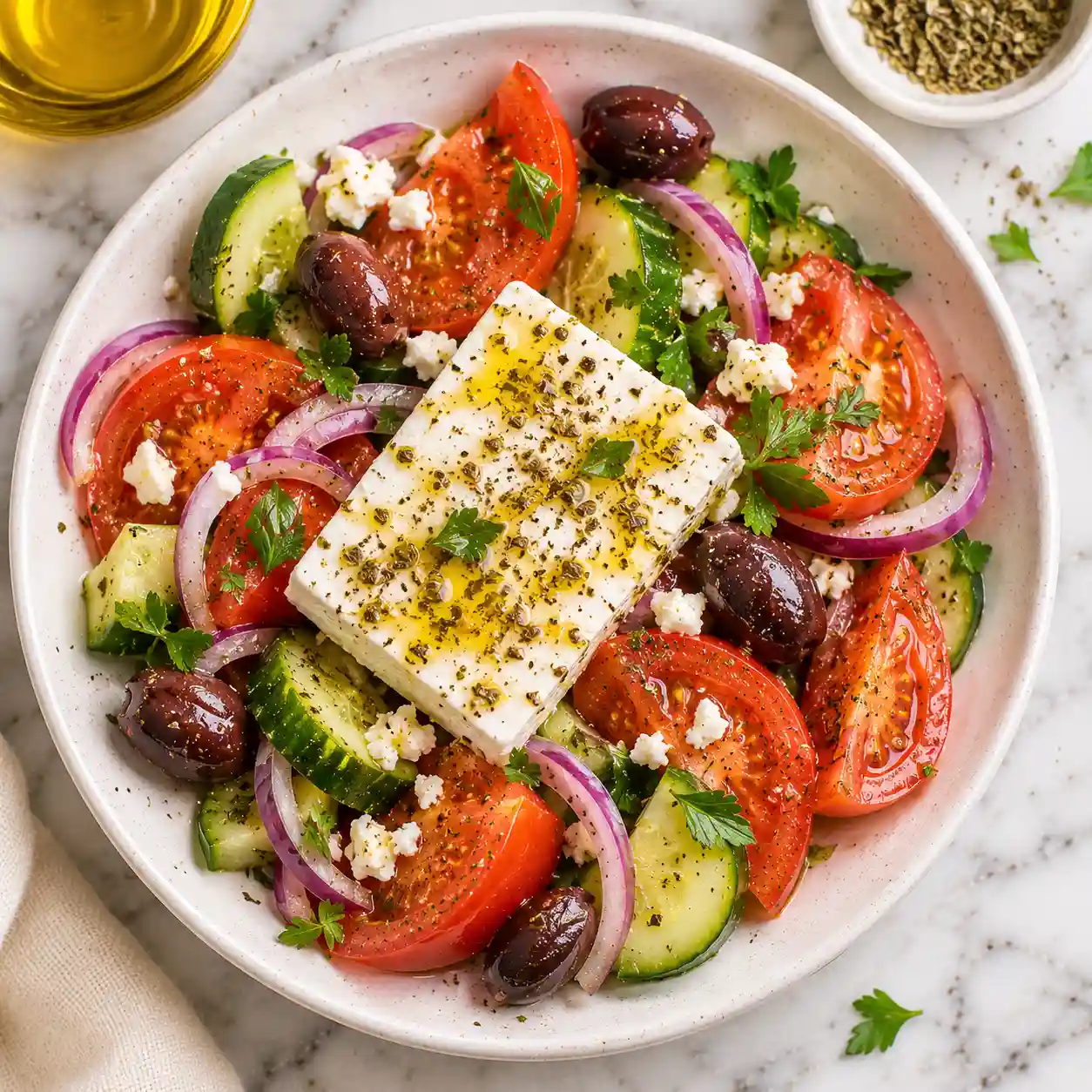
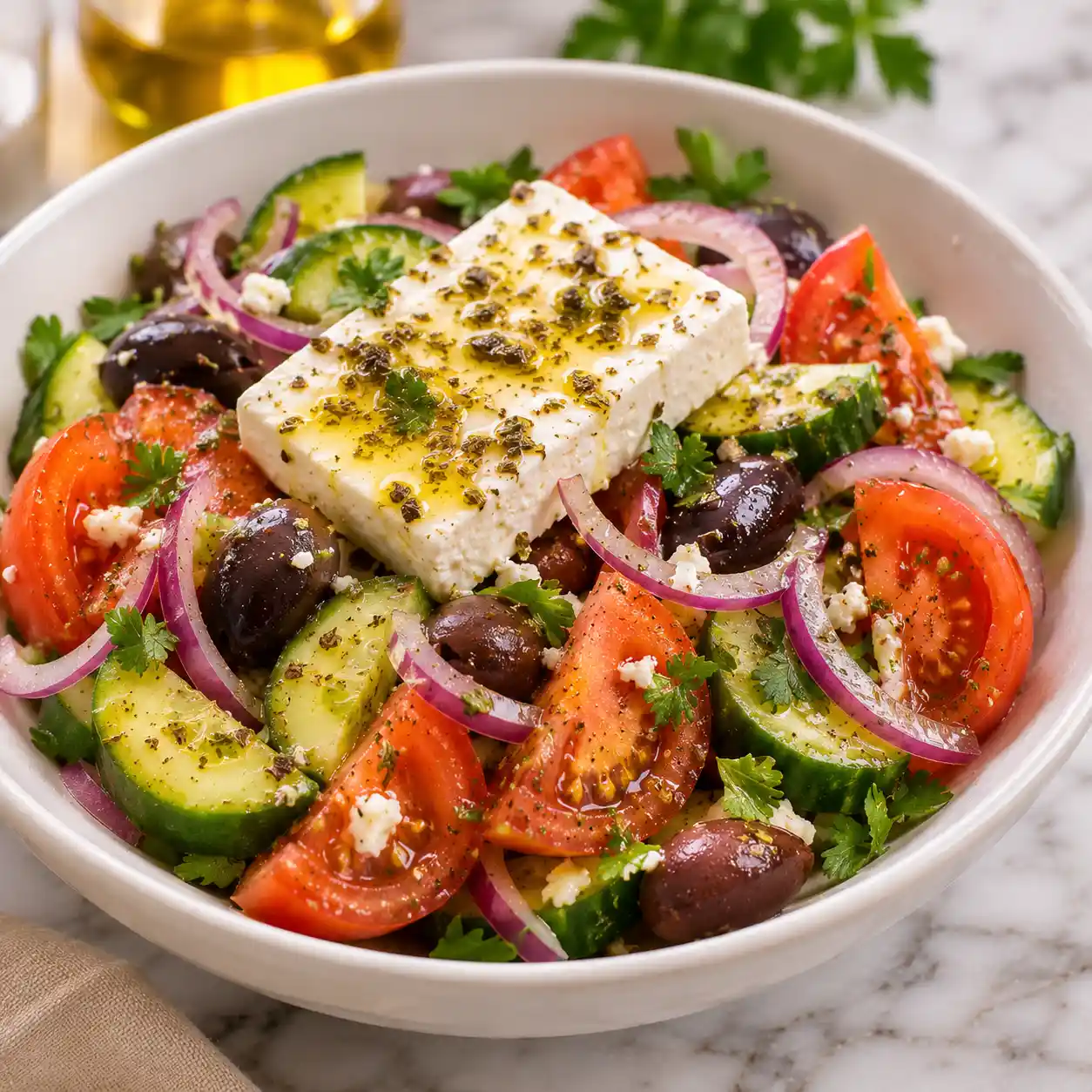
Step 6: Crown with feta. Place the feta slab on top, leaving it whole instead of mixing it in. Drizzle the last of the dressing over the cheese and scatter a pinch of oregano across the surface. The white block should look shiny with oil and speckled with green flecks.
Chef’s Note: A whole piece of feta keeps its creamy texture and lets each person break off exactly as much as they want.
[AI IMAGE PROMPT: A thick feta slab resting on top of tossed Greek salad in a deep white ceramic salad bowl on a white marble surface, olive oil glistening, dried oregano falling in a fine shower, warm kitchen light, top down flat lay.]
[IMAGE PLACEHOLDER: alt text: “Feta slab on top of tossed Greek salad with oregano” | filename: “greek-salad-adding-feta.jpg” | orientation: horizontal]
Step 7: Rest, then serve. Let the bowl sit at room temperature for 5 minutes so the tomato juices blend with the dressing. Bring it to the table with a spoon big enough to scoop up the liquid from the bottom. It is ready when a shallow pool of pink, oily juice has collected at the base.
Expert Tips & Tricks
- Cut thick for crunch: Pieces around 1/2 inch hold their snap and keep their juice. Thin slices wilt fast once they meet salt and acid.
- Chill your bowl: A cold bowl keeps the vegetables crisper for the first 30 minutes on a warm day. Ten minutes in the fridge or freezer is enough.
- My watery bowl mistake: I once salted the chopped tomatoes ten minutes before serving and ended up with pink soup. Now all the salt goes into the dressing, and the vegetables stay dry until the toss.
- Make ahead dressing: The dressing keeps in a sealed jar in the fridge for up to 5 days. Let it sit out for 10 minutes and shake well, since the oil may firm up when cold.
- Storage tip: Keep unused feta submerged in its own brine. If the brine is gone, dissolve 1 teaspoon of salt in 1 cup of water and use that.
- Time saver: Buy pitted olives and Persian cucumbers, which have tiny seeds and need no peeling or scooping.
Common Mistakes & Troubleshooting
| Problem | Why It Happens | How to Fix or Prevent It |
| Pool of watery liquid in the bowl | Salt on cut vegetables draws out juice, or the produce went in wet | Dry everything well, salt only the dressing, and toss right before serving |
| Tomatoes taste bland | They were underripe or chilled in the fridge | Use ripe tomatoes kept at room temperature, or swap in sweet cherry tomatoes in cooler months |
| Onion tastes harsh | Raw onion carries strong sulfur compounds | Soak the slices in cold water for 5 minutes and drain well |
| Dressing separates on the plate | Oil and lemon naturally split without agitation | Shake the jar hard right before pouring |
| The whole bowl tastes too salty | Feta and olives already carry plenty of brine | Add the dressing salt in stages and taste after tossing. I once used the full amount plus brined feta and regretted it |
Storage, Reheating, Freezing, Make Ahead
Refrigerator: Store chopped cucumber, pepper, and onion in an airtight glass container lined with a folded paper towel for up to 24 hours. Fully dressed leftovers keep for about 1 day, but the texture softens, so drain extra juice before eating. Keep tomatoes in their own container if you slice them early.
Freezer: Freezing is not recommended for the finished salad, since cucumber and tomato turn mushy after thawing. Feta can be frozen in a sealed bag for up to 3 months, though it becomes crumbly and works best in cooked dishes.
Reheating: This salad is meant to be eaten cold. If it has been chilled, let it sit out for 10 minutes before serving so the flavors open up.
Make ahead: Mix the dressing up to 5 days ahead and chop the sturdy vegetables the day before. Slice the tomatoes, add the dressing, and top with feta only in the last 15 minutes.
Personal storage tip: A folded paper towel under the lid soaks up excess moisture and noticeably extends the crunch of cucumbers.
Callout Box: Keep the Feta in Brine. Storing feta dry makes it salty and crumbly within a few days. Submerged in its brine, it stays creamy and lasts up to a week after opening.
[AI IMAGE PROMPT: Two clear glass containers with snap lids on a white marble surface, one holding chopped Greek salad vegetables, the other holding creamy feta slices in cloudy brine, a small glass jar of dressing beside them, soft natural daylight, 45 degree food photography angle.]
[IMAGE PLACEHOLDER: alt text: “Glass containers of chopped Greek salad vegetables and feta in brine” | filename: “greek-salad-storage-containers.jpg” | orientation: horizontal]
Variations & Substitutions
- Chickpea Greek salad (vegetarian): Stir in one 15 ounce can of rinsed, drained chickpeas for extra protein and a more filling bowl.
- Grilled chicken Greek salad: Add about 1 pound of sliced grilled chicken breast and serve it as a full dinner.
- Spicy version: Add 1/2 teaspoon red pepper flakes to the dressing and a handful of sliced pepperoncini to the bowl.
- Mild, kid friendly version: Leave out the onion and olives, cut everything into small pieces, and use cubes of mild mozzarella if feta tastes too sharp.
- Dairy free version: Replace the feta with marinated extra firm tofu, and add an extra pinch of salt to the dressing.
- Gluten free: This Greek salad is naturally gluten free as written. Just check packaged olives and cheese for added flavorings.
Serving Suggestions
- Pair it with grilled chicken or lamb skewers, such as these [INTERNAL LINK: grilled chicken souvlaki recipe].
- Add a bowl of creamy [INTERNAL LINK: homemade tzatziki] for dipping and spooning.
- Serve with warm [INTERNAL LINK: soft pita bread recipe] to mop up the juices at the bottom.
- Sprinkle extra oregano and a final drizzle of olive oil on top for a restaurant look.
- Offer sparkling water with lemon and fresh mint to keep the meal light.
- Spoon it over warm rice or couscous for a quick, filling lunch bowl.
Nutrition Information
Serving size: 1 portion (about 360 g) | Servings per recipe: 4
| Nutrient | Amount |
| Calories | 305 kcal |
| Protein | 8 g |
| Carbohydrates | 13 g |
| Fiber | 3.5 g |
| Sugar | 8 g |
| Fat | 25 g |
| Saturated Fat | 9 g |
| Cholesterol | 38 mg |
| Sodium | 850 mg |
Notable micronutrients: vitamin C from the tomatoes and pepper, calcium from the feta, and vitamin K from the cucumber. These numbers are estimates and will shift with brand, ingredient size, and how you measure.
Why This Greek Salad Works
Every ingredient does a specific job. Salty feta and olives season the bowl from within, so the vegetables need very little added salt. The acid in the lemon juice brightens the tomatoes and cucumber, while the olive oil carries the fat soluble flavor compounds in oregano and spreads them across every piece.
Texture matters just as much as taste. Thick cuts hold their structure because less surface area is exposed to salt, and salt draws water out of plant cells gradually. By holding the salt inside the dressing and tossing late, you keep the cell walls firm and the juices where they belong.
The short rest is a small step with a large payoff. During those five minutes, tomato juice dilutes the oil and lemon into a loose, savory sauce that clings to the vegetables. Skip the rest and the flavors taste separate, rather than blended into one.
Frequently Asked Questions
FAQ Source Note: These questions reflect common question patterns around Greek salad searches, such as People Also Ask style and forum style questions. They were not pulled from live search results.
Can I make Greek salad ahead of time?
Yes, but only in parts. Chop the cucumber, pepper, and onion up to 24 hours ahead and keep them in an airtight container with a paper towel. Slice tomatoes, add olives, dressing, and feta within the last 15 minutes. Dressed Greek salad turns soft and watery after a couple of hours, while the dressing itself stays good in a sealed jar in the fridge for up to 5 days.
Why is my Greek salad watery?
Water comes from two places: salted tomatoes and wet vegetables. Salt pulls juice out of cut produce within minutes, and damp cucumber or pepper adds more. Dry everything with a towel, keep salt inside the dressing, and toss just before serving. Choosing firm tomatoes and cutting them into thick wedges also reduces runoff. A little pink juice at the bottom is normal, and it tastes great with pita.
What can I use instead of feta in Greek salad?
Firm ricotta salata, halloumi, or fresh goat cheese all work, though each changes the taste. Ricotta salata is the closest in saltiness, while goat cheese brings a creamier, tangier bite. For a dairy free Greek salad, marinate cubes of extra firm tofu in lemon juice, salt, and a spoonful of olive oil for 30 minutes. Add a pinch more salt to the dressing whenever you swap in a milder cheese or tofu.
How do I know when the salad is ready to serve?
Greek salad is ready after a 5 minute rest, once the tomatoes look glossy and a shallow pool of pink, oily juice gathers at the bottom of the bowl. Cucumber should still snap when bitten, and the onion should taste mellow rather than sharp. If the vegetables look dull or dry, drizzle a teaspoon of olive oil over the top and fold twice more before serving.
Is Greek salad gluten free and dairy free?
Greek salad is naturally gluten free, as long as your packaged olives and cheese carry no added flavorings or fillers. It is not dairy free because feta is usually made from sheep milk, goat milk, or a blend of both. To remove the dairy, swap in marinated tofu or a plant based feta, and always check labels carefully if you are cooking for someone with a serious allergy.
Does a real Greek salad have lettuce?
No, the classic village style version, called horiatiki in Greece, skips lettuce completely. It relies on tomato, cucumber, pepper, onion, olives, and feta, with a thick slab of cheese on top. Many restaurants outside Greece add romaine for volume, and that works if you like it. For the closest match to the original, keep this Greek salad lettuce free and serve it with bread for mopping up the juices.
Conclusion
This Greek salad has become my default whenever the weather is warm and the main dish is rich. After a lot of bowls, the lessons are simple: keep the vegetables chunky, season the dressing instead of the vegetables, and give the bowl five quiet minutes before anyone digs in. Those small habits are what separate a crisp, juicy salad from a watery one.
Some of my best batches came from the simplest changes, like pulling the tomatoes out of the fridge an hour early. Make it once exactly as written, then adjust the onion, olives, or lemon to match your own taste. Bring a bowl to the next barbecue and watch how fast the juices disappear with a piece of warm pita.
If you loved this recipe, save it to your salad recipes Pinterest board so you can find it easily later!
Greek Salad
Ingredients
Method
- Instructions:
- Combine the olive oil, lemon juice, oregano, salt, and pepper in a lidded glass jar and shake for 20 seconds until cloudy and slightly thick. Let it rest while you chop.
- Wash and dry the cucumber and pepper. Cut the cucumber into 1/2 inch pieces and the pepper into thin rings.
- Cut the tomatoes into 6 wedges each. Soak the sliced onion in cold water for 5 minutes, then drain well.
- Place the cucumber, pepper, tomatoes, onion, and olives in a wide, shallow bowl.
- Pour on roughly three quarters of the dressing and fold gently until all the pieces shine.
- Rest the feta slab on top, drizzle with the remaining dressing, and finish with a pinch of oregano.
- Wait 5 minutes at room temperature, then serve once a pink, oily pool forms at the bottom of the bowl.
Notes
- Salt only the dressing, not the cut vegetables, to avoid a watery bowl.
- Store the dressing in a sealed jar in the fridge for up to 5 days and shake well before use.
- Keep leftover feta in its brine and use within one week of opening.
- Dressed leftovers keep about 1 day and soften with time.